Vision 2030 has turned the Kingdom into one of the world’s largest active construction zones, NEOM, Qiddiya, the Red Sea, Aramco‘s plants and fifteen FIFA World Cup 2034 stadiums are all being built at once. Every one of those sites needs a defibrillator that can survive Saudi heat, dust and distance from the nearest hospital. An automated external defibrillator (AED) can form an important part of an organization’s emergency response plan. Here is how the three most-searched AEDs actually compare.
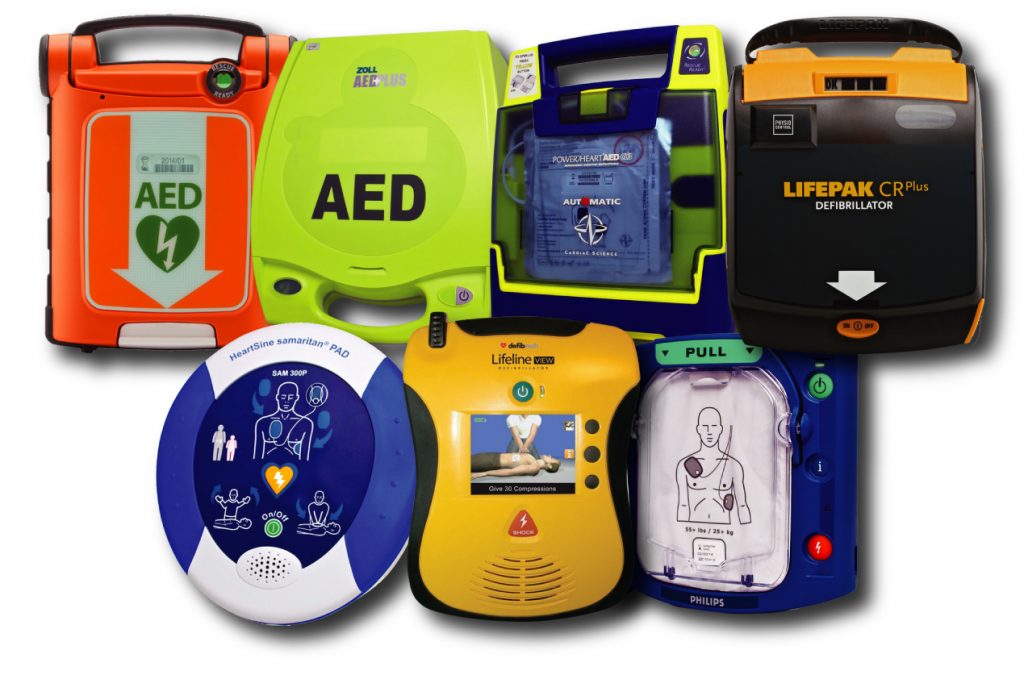
For companies researching an AED machine in Saudi Arabia, three established models frequently considered are:
- ZOLL AED 3
- Philips HeartStart FRx
- Defibtech Lifeline AED
This guide compares the three models and explains where each type of AED can fit within Saudi workplaces, industrial facilities, construction projects, schools, sports venues, hotels, offices and public-access locations.

ZOLL AED 3 vs Philips HeartStart FRx vs Defibtech Lifeline
Compare ZOLL AED 3, Philips HeartStart FRx and Defibtech Lifeline AEDs for Saudi Arabia. See features, durability, pediatric options and suitable industries across KSA.
7–10% : Estimated drop in survival odds for every minute a sudden cardiac arrest victim goes without defibrillation, which is why the AED closest to the patient, not the AED with the longest spec sheet, is usually the one that saves a life.
Why AEDs Matter in Saudi Arabia
Saudi Arabia’s workplace environment includes a wide range of higher-risk and high-occupancy locations. These include:
Oil and gas facilities
Construction sites
Power plants
Mining operations
Hotels and resorts
Shopping malls
Sports stadiums
Fitness centers
Corporate offices
Airports
Saudi labor requirements already place responsibilities on employers concerning occupational safety, worker protection, emergency preparedness and first aid. Saudi Arabia’s Ministry of Human Resources and Social Development states that employers must take necessary precautions to protect workers from workplace hazards and provide appropriate safety measures. Its labor guidance also refers to medical-aid cabinets equipped with materials necessary for first aid.
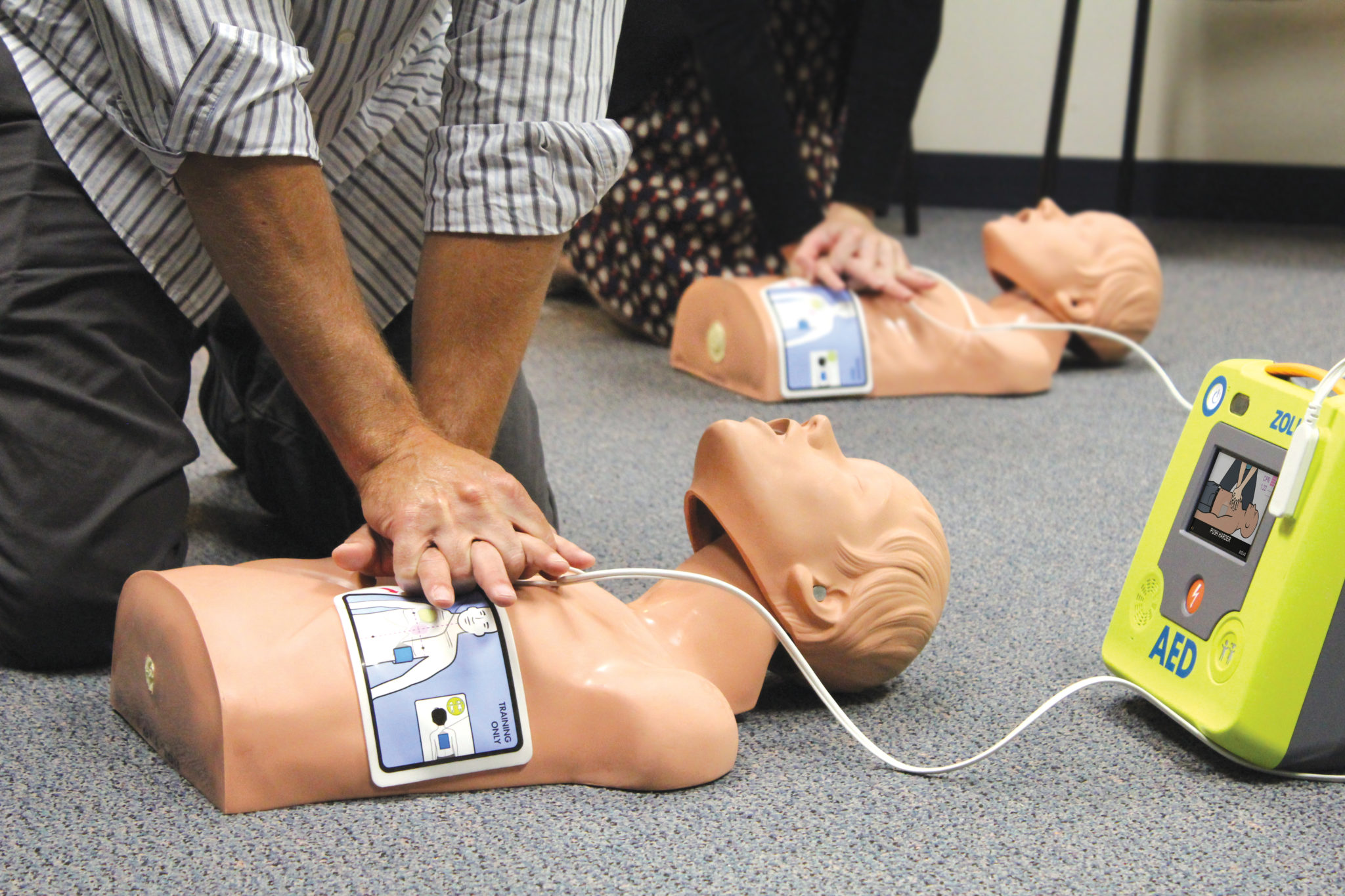
An AED does not replace professional emergency medical care. Instead, it can be incorporated into a broader emergency-response program involving trained personnel, CPR, first aid, emergency communications and rapid access to professional medical services.
Quick Answer: Which AED Should You Buy?
There is no single “best” AED for the whole Kingdom: there is a best AED for your site. In short:
Indoor · High-traffic ·
Managed fleets
ZOLL AED 3
Malls, hospitals, hotels, corporate towers, banks and airports where WiFi status-checking across many units matters.
Outdoor · Industrial ·
Extreme heat
Philips HeartStart FRx
Aramco plants, construction camps, stadium build-sites, oilfields and remote NEOM work zones
Budget-conscious · Schools ·
Multi-site rollouts
Defibtech Lifeline
Schools, mosques, gyms, retail branches and any organisation equipping many locations at once.
Why Saudi Arabia Needs a Different AED Buying Strategy
Three things make the Saudi market unlike the US or European markets these AEDs were originally designed for:
Extreme, sustained heat
Riyadh, Jeddah, Dammam and the Eastern Province regularly see 45–50°C in summer, with equipment often stored in vehicles, portacabins or exposed guard posts rather than air-conditioned offices.
Dust and sandstorms
Frequent shamal winds push fine sand into any unsealed enclosure, which is exactly why IP-rated, dust-tight housings matter far more here than in a typical European office building.
Import & regulatory rules
Every medical device sold in the Kingdom needs to clear the Saudi Food and Drug Authority (SFDA), so the "best" AED on paper is only useful if the exact model and accessories are registered and locally supported.
Distance from hospitals
Giga-projects like NEOM and the Red Sea sit hours from the nearest tertiary hospital, so an on-site AED plus a trained responder is often the only realistic bridge to survival.
Note: Regulations and import pathways change. Always confirm current SFDA Medical Device Marketing Authorization (MDMA) status for the exact model, configuration and accessory kit you plan to buy with a licensed local distributor before purchasing.
ZOLL AED 3 vs Philips HeartStart FRx vs Defibtech Lifeline: Full Specification Comparison
Here is how the standard, most commonly quoted configuration of each device compares on the specifications that matter most in Saudi conditions. Optional models (ZOLL BLS, Philips OnSite/FR3, Defibtech VIEW) add extra screens and monitoring, so confirm the exact variant with your supplier.
Core specifications – ZOLL AED 3, Philips HeartStart FRx, Defibtech Lifeline (standard semi-automatic configurations)
| Specification | ZOLL AED 3 | Philips HeartStart FRx | Defibtech Lifeline |
|---|---|---|---|
| Display | Full-colour LCD touchscreen with rescue images | No screen, voice and light prompts only | No screen on base model LED and voice prompts |
| CPR feedback | Real-time depth & rate feedback (Real CPR Help + CPR Dashboard) | Voice-guided metronome, no real-time depth measurement | Voice-guided metronome, no real-time depth measurement |
| Rhythm analysis | RapidShock analysis, as fast as roughly 3 seconds | Standard automated ECG analysis | Standard automated ECG analysis |
| Ingress protection (IP) | IP55 dust-tight, protected against water jets | IP55 dust-tight, protected against water jets | IP54 on the base model (IP55 on the Lifeline VIEW) |
| Operating temperature | 0°C to 50°C typical operating range | 0°C to 50°C standard, wider transient/storage tolerance | 0°C to 50°C typical operating range |
| Drop / crush rating | 1-metre drop tested | 500 lb crush test, MIL-STD-810F vibration rated | 1-metre drop, MIL-STD-810F shock & vibration tested |
| Weight (with battery & pads) | ~2.7 kg (6 lb) | ~1.6 kg (3.5 lb) | ~1.4–1.9 kg depending on model |
| Pediatric use | Integrated child mode on the same Uni-padz electrodes | Infant/Child Key switches energy level | Separate pediatric pad set required |
| Connectivity | Optional WiFi for fleet-wide remote status monitoring | USB data transfer, no built-in WiFi on base model | Optional WiFi self-check alerts, USB/data-card export |
| Battery life (standby) | ~5 years | ~4 years | ~5-7 years depending on configuration |
| Electrode/pad life | ~5 years (Uni-padz) | ~2 years | ~2 years |
| Warranty | 6 years standard (up to 8 with registration) | Typically 8 years | Typically 8 years |
| Typical positioning | Premium, fleet-managed, indoor/controlled environments | Rugged, mission-critical, outdoor/industrial | Value-focused, straightforward, high-volume rollouts |
Specifications summarised from manufacturer literature current at the time of writing. Always verify against the latest datasheet and the SFDA-registered configuration before purchase, since manufacturers periodically update models.
ZOLL AED 3: Best for Hospitals, Malls and Managed Corporate Fleets

ZOLL AED 3
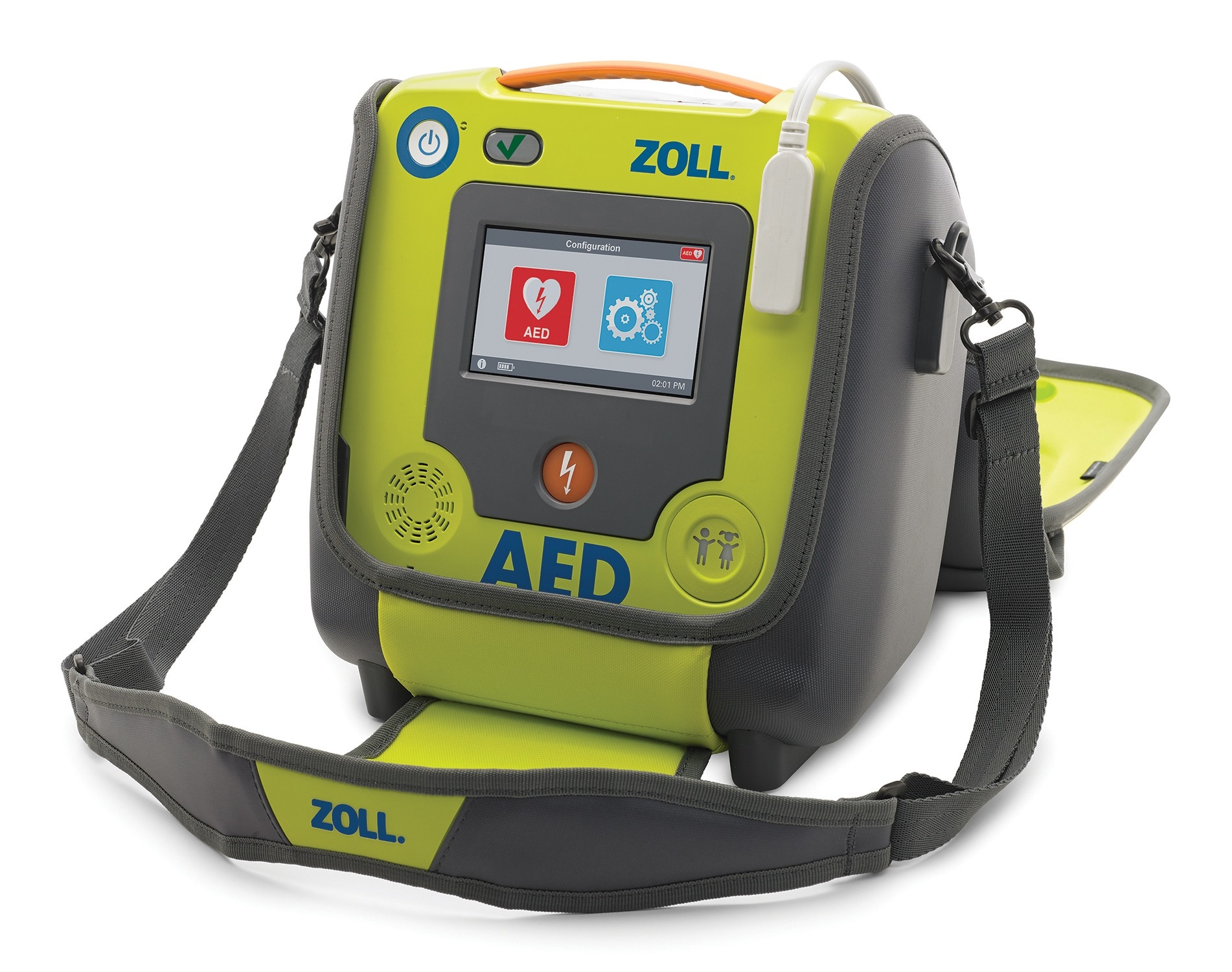
The ZOLL AED 3 is built around one idea: give a nervous bystander real-time coaching, not just instructions. Its colour touchscreen shows live compression depth and rate through Real CPR Help, and its RapidShock analysis is designed to read the heart rhythm and get to a shock decision faster than a standard AED, shortening the dangerous pause in chest compressions.
The same CPR Uni-padz electrodes work for both adults and children with a simple child-mode switch, and the optional WiFi link reports battery and pad status back to a central dashboard - genuinely useful for a facilities team managing dozens of units spread across a tower, hospital campus or shopping mall.
Real-time CPR feedback
Touchscreen guidance
Fleet WiFi monitoring
IP55 rated
Best for in Saudi Arabia: Riyadh and Jeddah corporate headquarters, private hospitals and clinics, five-star hotels, airports, shopping malls, universities and any organisation running a centrally managed AED programme across several buildings.
Philips HeartStart FRx: Built for Aramco Sites, Construction and Desert Heat

Philips HeartStart FRx
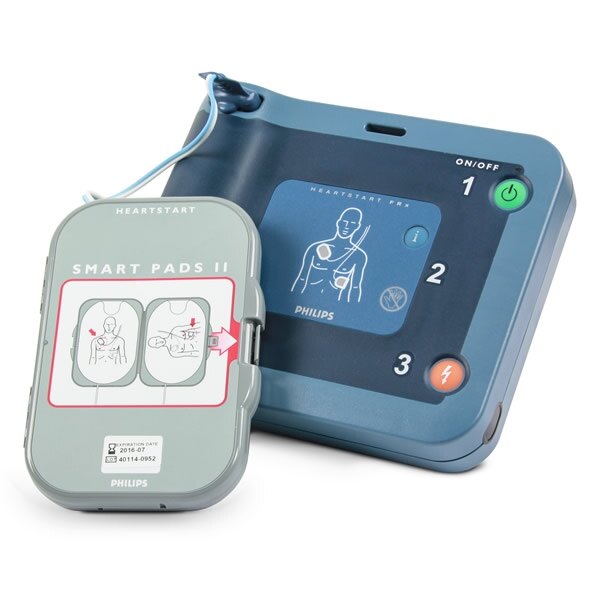
The HeartStart FRx was designed for people who will never open a manual under pressure: a two-button interface, pre-connected SMART Pads II, and a simple Infant/Child Key that switches energy delivery for pediatric rescues without changing pads. What sets it apart in Saudi Arabia is durability - it carries an IP55 rating, has passed a 500 lb crush test, and is built to MIL-STD-810F vibration standards, with a temperature range engineered for use in vehicles, engine compartments and site cabins rather than climate-controlled offices.
That combination of toughness and simplicity is why the FRx is one of the most common AEDs found on oil and gas facilities, remote industrial sites and sports fields worldwide the exact conditions found across Saudi Aramco's operating areas and the Kingdom's giga-project construction camps.
IP55 dust & water rated
500 lb crush tested
MIL-STD-810F vibration rated
Lightweight, 3.5 lb
Best for in Saudi Arabia: Aramco and SABIC plants in Dhahran, Jubail and Yanbu, construction camps at NEOM and Qiddiya, oilfield and offshore facilities, stadium build-sites, security vehicles and desert logistics operations.
Defibtech Lifeline: The Value Choice for Schools and Multi-Site Rollouts

Defibtech Lifeline
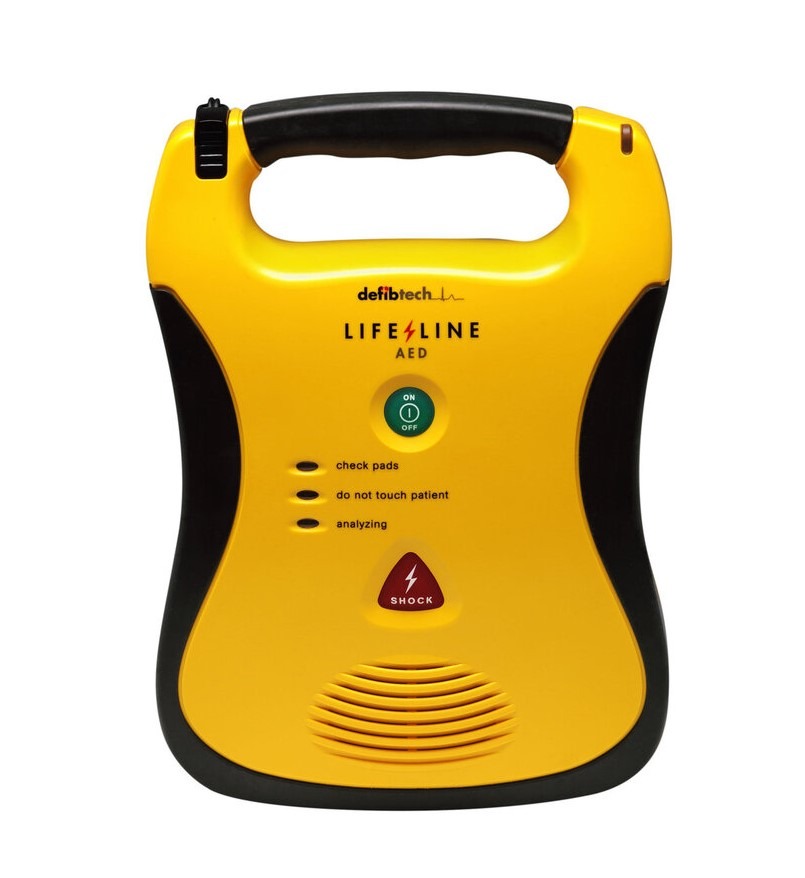
The Defibtech Lifeline strips the AED down to what a first-time rescuer actually needs: loud, clear voice prompts, a bright LED status light, and a rugged case tested to military shock-and-vibration standards. It carries an IP54 rating as standard (the higher-spec Lifeline VIEW model, which adds a small screen and live ECG display, steps up to IP55), and its long battery standby life keeps ongoing maintenance costs low.
Where the Lifeline earns its reputation is value at scale. For a school system, retail chain, mosque committee or logistics company that needs to equip ten, fifty or a hundred sites at once, its lower per-unit cost and straightforward two-button operation make a fleet-wide rollout far more affordable without giving up biphasic defibrillation therapy or automated self-testing.
IP54 rated (IP55 on VIEW)
Two-button simplicity
Long battery standby
Lowest cost per unit
Best for in Saudi Arabia: public and private schools, universities, mosques, gyms and sports clubs, retail and F&B chains, and any organisation equipping many low-risk sites on a defined budget.
Where Saudi Arabia's Biggest Projects and Industries Need an AED
Vision 2030 has created one of the largest concentrations of active construction, industrial and public-gathering sites in the world. Each sector below carries its own cardiac-arrest risk profile, and, usually, a clear best-fit AED.
Oil, Gas & Petrochemicals - Saudi Aramco and SABIC
Saudi Aramco’s refineries, gas plants and drilling operations across Dhahran, Jubail, Yanbu and Ras Tanura run large shift-based workforces in high-heat, high-noise, physically demanding conditions, a well-documented risk factor for cardiac events. Aramco’s own naming of the new Aramco Stadium in Al Khobar for the FIFA World Cup 2034 reflects just how central the company is to the Kingdom’s broader infrastructure push. Rugged, mil-spec devices like the Philips HeartStart FRx and the Defibtech Lifeline are the natural fit for control rooms, workshops and remote wellheads.
Giga-Projects & Construction - NEOM, Qiddiya, Red Sea, ROSHN, New Murabba, Diriyah
The Public Investment Fund’s six giga-projects, NEOM on the Red Sea coast, the entertainment-focused Qiddiya southwest of Riyadh, the luxury-tourism Red Sea destination, nationwide developer ROSHN, the new downtown New Murabba, and the heritage development at Diriyah, together represent one of the largest construction workforces on the planet, much of it working outdoors through Saudi summers. Site clinics, labour camps and heavy-machinery zones on these projects benefit most from IP55-rated, temperature-tolerant AEDs that can sit in an unshaded guard hut for years and still fire on day one.
Sports Infrastructure & the FIFA World Cup 2034
Saudi Arabia will host the FIFA World Cup 2034 across fifteen stadiums in five cities, eight in Riyadh (including the flagship King Salman Stadium and the cliffside Prince Mohammed bin Salman Stadium at Qiddiya), four in Jeddah, one in Al Khobar, one at NEOM, and one in Abha. Every one of these venues is either under construction or being expanded now, ahead of interim events like the 2027 AFC Asian Cup. That means thousands of construction workers on scaffolding and cranes today, and hundreds of thousands of fans, players and staff inside high-density stadium bowls tomorrow. Both phases call for AEDs: rugged units for the build phase, and fast, easy-to-use, high-visibility units such as the ZOLL AED 3 stationed at fan gates, concourses and medical points once the stadiums open.
Hospitality & Tourism - Red Sea Global, Amaala, Diriyah, Riyadh Season
As the Kingdom pushes to attract international visitors through resorts, mega-events and entertainment districts, hotels, resorts and event venues need AEDs that guests and untrained staff can operate with confidence. Wall-mounted cabinets with a display-driven device like the ZOLL AED 3 fit front-of-house areas, while ruggedised units suit remote island and desert resort locations still being built out along the Red Sea coast.
Healthcare & Corporate Facilities
Private hospital groups, clinics, insurance-linked wellness centres and corporate headquarters across Riyadh, Jeddah and the Eastern Province are increasingly building formal emergency-response programmes, often pairing an AED with CPR-trained first-aid teams as part of occupational health compliance and insurance requirements.
Education - Schools, Universities & Training Institutes
With school populations and university campuses growing alongside the Kingdom’s demographic boom, education providers are natural candidates for budget conscious, easy-to-use devices that non medical staff can be trained on quickly, a strong use case for the Defibtech Lifeline across a multi-campus rollout.
Religious Sites - Makkah, Madinah, Hajj & Umrah Operations
The Two Holy Mosques host tens of millions of pilgrims a year, many elderly and undertaking physically demanding rites in intense heat, a combination that raises cardiac risk sharply during Hajj and Ramadan Umrah seasons. Emergency medical teams operating in and around Masjid al-Haram and Masjid an-Nabawi rely on portable, heat-tolerant AEDs that can be carried through dense crowds and deployed in seconds.
Public Transport & Aviation - Airports, Riyadh Metro, Rail
Saudi Arabia’s expanding aviation hubs and the new Riyadh Metro network bring together large volumes of the public in enclosed spaces, which is exactly the setting where a fast, guided device like the ZOLL AED 3 or a compact, aviation-recognised design like the Philips HeartStart FRx is typically deployed at transport authorities worldwide.
Manufacturing & Industrial Cities - Jubail, Yanbu, King Abdullah Economic City
The Kingdom’s dedicated industrial cities combine heavy machinery, extreme ambient heat and large blue-collar workforces, the same profile as an Aramco site, and the same case for rugged, IP-rated AEDs positioned at accessible points across the plant floor.
Sector-by-Sector Recommendation at a Glance
Core specifications : ZOLL AED 3, Philips HeartStart FRx, Defibtech Lifeline (standard semi-automatic configurations)
| Sector / Site Type | Suggested AED | Why |
|---|---|---|
| Oil & gas plants, refineries (Aramco, SABIC) | Philips HeartStart FRx | Crush & vibration rated, wide temperature tolerance |
| Giga-project construction sites (NEOM, Qiddiya, Red Sea) | Philips HeartStart FRx | IP55 sealing for dust and heat exposure |
| World Cup 2034 stadium build phase | Defibtech Lifeline | Cost-effective for large, multi-site crews |
| World Cup 2034 stadiums, fan zones (in operation) | ZOLL AED 3 | Fast guidance for untrained crowd responders |
| Hospitals, clinics, wellness centres | ZOLL AED 3 | Real-time CPR data and clinical-grade feedback |
| Hotels, malls, airports | ZOLL AED 3 | Central WiFi fleet monitoring across sites |
| Schools & universities | Defibtech Lifeline | Low cost per unit for multi-campus rollout |
| Mosques, Hajj & Umrah operations | Philips HeartStart FRx | Lightweight, rugged, heat-tolerant for crowds |
| Industrial cities (Jubail, Yanbu, KAEC) | Philips HeartStart FRx | Built for plant-floor and outdoor exposure |
| Retail chains, gyms, F&B outlets | Defibtech Lifeline | Simple operation, affordable at scale |
SFDA Compliance and Buying an AED Locally in Saudi Arabia
Before comparing brands, confirm the paperwork. In Saudi Arabia, every AED must have a valid Medical Device Marketing Authorization (MDMA) from the Saudi Food and Drug Authority (SFDA) before it can be imported and sold. In practice, this means:
Buy through a authentic supplier
Work with an SFDA-licensed medical device establishment that can show the MDMA certificate for the exact model and pad/battery accessories you are purchasing.
Confirm local service support
Ask how pad and battery replacements, firmware updates and warranty claims are handled inside the Kingdom, not just at the manufacturer's overseas headquarters.
Check Arabic labeling
Registered devices should carry Arabic-language labeling and documentation alongside the original English manuals.
Match the device to your HSE plan
Large employers, including those operating under Aramco and giga-project HSE frameworks, should align AED placement with an emergency response plan and staff CPR/AED training.
Frequently Asked Questions
Which AED brand is approved for sale in Saudi Arabia?
ZOLL, Philips and Defibtech all hold international CE and FDA clearances, and each can be legally sold in the Kingdom once the specific model is registered with the SFDA and imported through an SFDA approved medical device distributor. Always ask your supplier for the SFDA MDMA number and Arabic-language labeling before you buy.
What is the best AED for outdoor sites in Saudi Arabia's heat?
For outdoor, dusty or high-heat sites such as construction projects, oil and gas facilities and stadium build-sites, the Philips HeartStart FRx and the Defibtech Lifeline are generally the strongest fit thanks to their rugged IP55/IP54 housings and wide operating-temperature tolerance. The ZOLL AED 3 is better suited to climate-controlled indoor environments such as offices, hospitals, malls and hotels.
How much does an AED cost in Saudi Arabia?
Landed prices vary by model, warranty and accessory package, and move with import duty and exchange rates, so ask a local SFDA-licensed distributor for a current quotation rather than relying on a fixed figure. Factor in total cost of ownership too, replacement pads roughly every 2 years, and batteries roughly every 4 to 7 years depending on the model.
Do construction sites in Saudi Arabia need an AED?
There is no single nationwide law naming a specific brand, but Saudi occupational health and safety practice, including standards applied across Saudi Aramco sites and the Vision 2030 giga-projects, increasingly expects a workplace emergency response plan for sudden cardiac arrest on large or remote sites, particularly given heat stress and manual labour risk. Confirm current requirements with your project’s HSE department and the relevant municipal or Civil Defense authority.
Which AED has the longest battery life?
The ZOLL AED 3 and its CPR Uni-padz electrodes are both rated for roughly 5 years. The Philips HeartStart FRx battery is rated for about 4 years standby life, and the Defibtech Lifeline battery is rated for roughly 5 to 7 years depending on configuration, though its pads, like the FRx’s, are rated at around 2 years.
Can one AED brand cover both an office tower and a construction site?
Usually not efficiently. Most organisations with a mixed portfolio for example a developer with both a Riyadh headquarters and an active giga-project site, standardise on a rugged model like the Philips HeartStart FRx for outdoor/industrial locations and a feature-rich, fleet-monitored model like the ZOLL AED 3 for indoor corporate and public-facing sites.
Not sure which AED fits your site?
sales team will recommend the right model,
quantity and placement plan.
Final Word
The ZOLL AED 3, Philips HeartStart FRx and Defibtech Lifeline are all clinically proven, internationally certified devices the real decision for a Saudi buyer is not “which AED is better” but “which AED matches this site.” Choose the ZOLL AED 3 for indoor, high-traffic and centrally managed locations; the Philips HeartStart FRx for Aramco-style industrial sites and giga-project construction zones; and the Defibtech Lifeline when you need to equip many schools, mosques or branches without stretching the budget. Whichever you choose, pair it with SFDA compliant procurement, a maintenance schedule built for Saudi heat, and a trained response team because the fastest shock is always the one from the device that was actually placed, registered and ready.
Reviewed by the AED Arabia Equipment Team
We supply and service SFDA approved emergency medical equipment across Saudi Arabia, including AEDs, first-aid kit and workplace medical kits for industrial, hospitality and giga-project clients. This guide is for general information and is not medical or legal advice, confirm current SFDA requirements before purchasing.